How to Enter the Korean Perfume Spray Market: A Fragrance Packaging Success Case

For any cosmetic packaging manufacturer or perfume bottle supplier, entering the Korean market is not just about product quality—it requires precision engineering, strong supply chain execution, and the ability to meet extremely high sensory expectations.
This case study shows how Foshan Shikai Plastic Technology Co., Ltd., a professional fragrance spray bottle manufacturer, successfully partnered with a Korean distributor and achieved 470,000 units in first-year sales.
Phase 1: Product Selection – Passing the Real Market Test (Month 1–3)
The project did not begin with orders.
It began with elimination.
Unlike typical sourcing processes focused on price or lead time, the client had a clear priority:
they were not looking for more products—they were looking for products that could survive in the Korean market.
Instead of presenting only a few "safe options," we developed 20 different product solutions, covering:
● Fragrance profiles
● Spray system performance
● User experience and tactile feedback
● Packaging design and usability
The goal was simple:
not to rely on assumptions, but to let the market standard decide.
Over the next three months, each product underwent strict evaluation:
● Stability under varying conditions
● Fragrance longevity and layering performance
● Durability and usability of packaging in real scenarios
There was no "good enough."
Every detail determined whether a product stayed—or was eliminated.
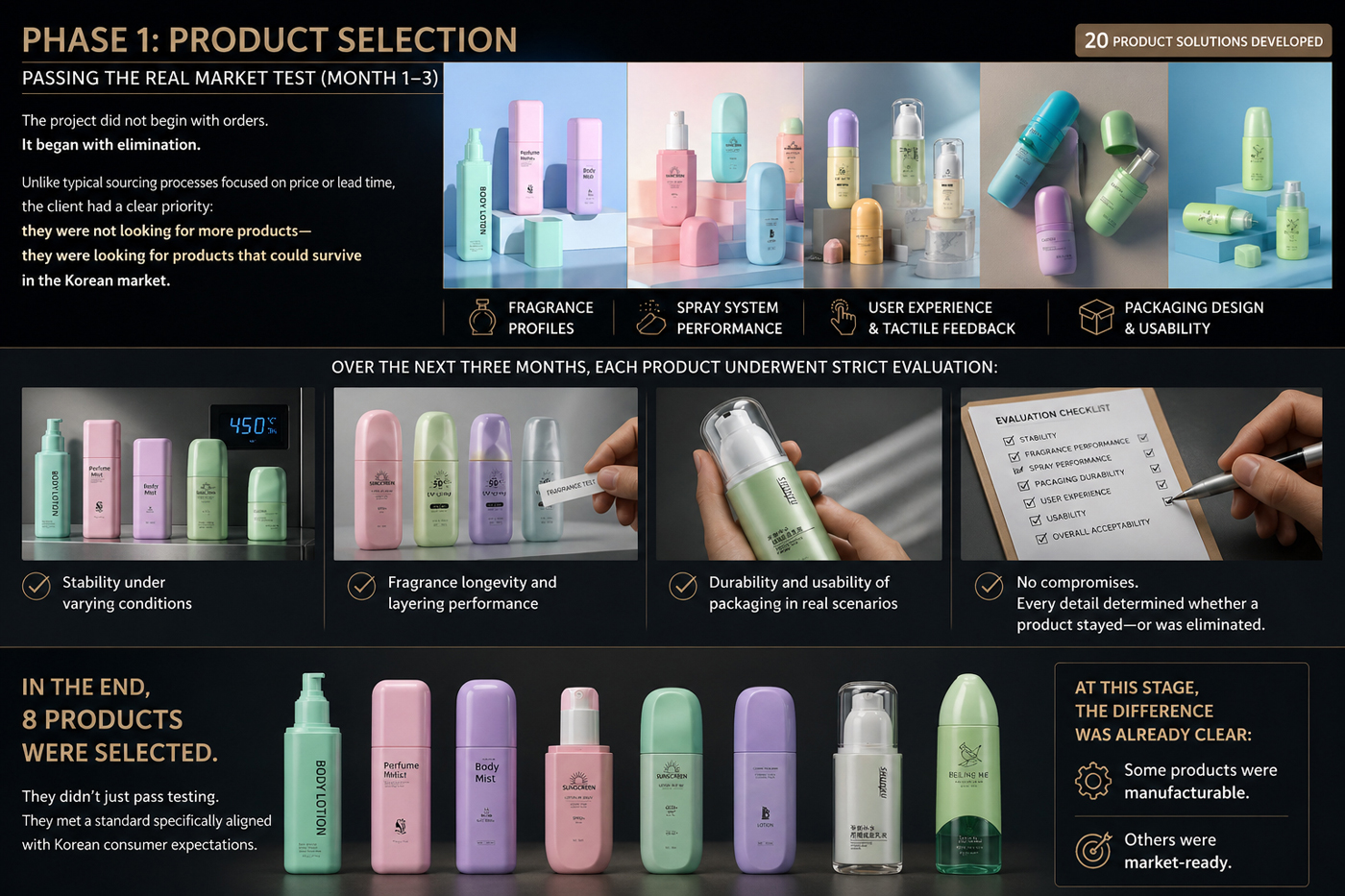
In the end, 8 products were selected.
They didn't just pass testing.
They met a standard specifically aligned with Korean consumer expectations.
At this stage, the difference was already clear:
Some products were manufacturable.
Others were market-ready.
Phase 2: From Validation to Rapid Execution (Month 4)
Once the products were confirmed, the pace changed immediately.
Many projects slow down at this stage—
internal approvals, production misalignment, repeated revisions.
This one didn't.
The client moved fast:
initial orders were placed without delay, and market launch preparation began simultaneously.
More importantly, the supply chain kept up.
There was no re-adjustment phase between sampling and mass production:
● Proven formulations and processes were directly transferred to production
● Manufacturing quickly reached stable output with consistent quality
● Packaging and labeling were finalized efficiently without iteration delays
● Shipment schedules aligned precisely with the client's market entry timeline
Instead of slowing down, the project accelerated.
This wasn't coincidence. It was the result of two aligned capabilities:
● Products were fully validated
● The supply chain was capable of executing without friction
At this point, the product completed a critical transition:
From "ready"
to "ready for market impact."

Phase 3: Market Performance and Scalable Growth (Month 5–12)
After launch, the real test began.
The challenge was not entering the market—
but staying relevant in it.
Early growth was steady, not explosive.
Products entered stores, gained visibility, and achieved first purchases.
In a highly competitive environment, even being selected once is a milestone.
Then momentum started to build.
As distribution expanded—from retail stores to e-commerce platforms—
products gained repeated exposure.
Familiarity increased.
Decision-making became easier.
Conversion improved.
At the same time, feedback loops were actively utilized:
● Which scents resonated most with consumers
●Which designs attracted attention
●Which details influenced final purchase decisions
These insights were not just collected—they were executed:
● Best-selling products were scaled quickly
● Underperforming ones were continuously optimized
In many cases, selling and improving are disconnected.
Here, they happened simultaneously.
Then came the turning point:
Repeat Purchase
When consumers chose the same product again,
it was no longer a "new option"—it became a preferred choice.
At that moment, growth logic shifted:
From pushing sales
to amplifying demand
Orders became more stable.
Volumes increased naturally.
Result: 470,000 Units in One Year
This was not driven by a single spike.
It was the result of continuous validation across product, channel, and supply chain.
And this is where the real gap emerges:
Some products are tried.
Others are remembered, repurchased, and scaled.
Why This Success Matters
This success was not accidental.
It reflects the alignment between
Foshan Shikai Plastic Technology Co., Ltd.'s precision manufacturing capabilities
and the high sensory standards of the Korean market.
South Korea is often seen as a global benchmark for beauty product quality.
Products that pass its rigorous buyer selection—and succeed at scale—
have already demonstrated their ability to compete in premium global markets.
Conclusion
Entering Korea is not just market expansion.
It is a validation process at the highest level.
And once a product proves itself there,
it carries the potential to succeed far beyond.
To Provide You With Professional Services

Request Free Sample