Custom Cosmetic Plastic Bottles for Canadian Beauty Brands | High-End Packaging Case Study

Project Core Overview
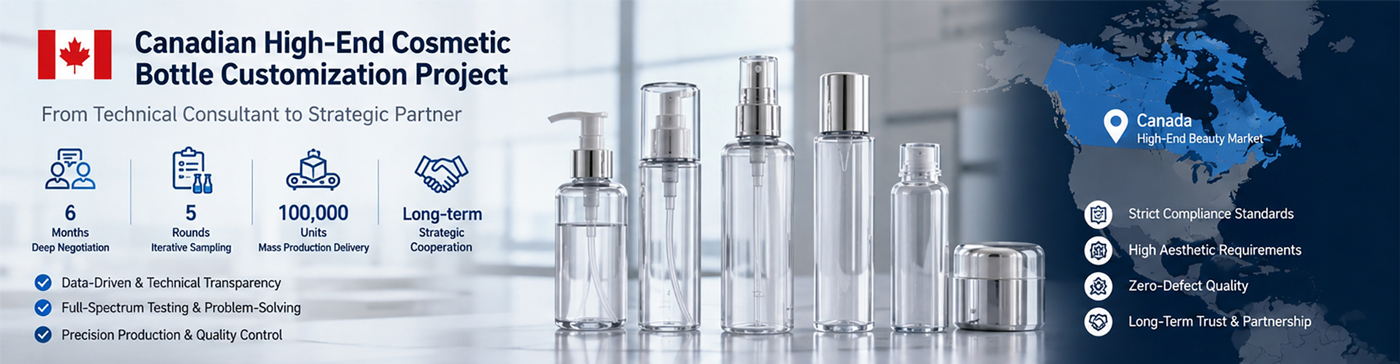
This Canadian cosmetic plastic bottle customization project broke away from the traditional “sales-driven, low-price order-taking” model. Acting as a dedicated technical consultant throughout, we engaged in six months of in-depth negotiations and five rounds of rigorous testing and sampling, systematically overcoming challenges in high-end cosmetic packaging—appearance aesthetics, sealing performance, material compatibility, and regulatory compliance. The successful completion and delivery of the initial 100,000-unit production run laid a solid foundation for future million-scale long-term orders. This collaboration was not only a comprehensive refinement of precision packaging processes but also a deep construction of cross-border business trust within the Canadian beauty industry.
Phase 1: Six Months of Deep Negotiation – Building Cross-Border Trust Through Consultative Communication
Canadian high-end beauty brands impose extremely stringent supplier selection criteria, with initial communication cycles far exceeding industry averages. This six-month engagement was not mere price negotiation; it was a holistic assessment of our professional capabilities, transparency,履约 reliability, and cross-cultural adaptability. It also served as a core phase for us to accumulate cross-border reputation capital.
1、Technical Transparency: Data-Driven Approach to Ease Decision-Making
1、Unlike the conventional single-quotation model, we adhered to a principle of “data first, technical transparency.” Beyond pricing, we proactively provided a complete manufacturing feasibility analysis report, addressing the client’s key concerns. For the core material selection of transparent cosmetic bottles, we conducted an in-depth comparison of high-transparency polypropylene (PP) and PET resin—covering material properties, application scenarios, and cost differences—while anticipating potential mass-production challenges such as wall thickness uniformity and molding stability. This data-backed approach significantly reduced the client’s decision-making risk and communication costs.
2、Cross-Cultural Adaptability: Meticulous Execution to Build Lasting Credibility
Canadian business culture places high value on timeliness, precision, and candid communication. Trust is built through consistent attention to every detail over time. Over the six-month communication period, we established a standardized engagement mechanism: after each meeting, we delivered accurate meeting minutes, synchronized progress logs, and defined follow-up tasks. For core cross-border pain points—such as USD exchange rate fluctuations, plastic resin price volatility, and supply chain lead time variations—we openly shared risks and solutions, avoiding concealment or evasion.
This stable, sincere, and professional service model perfectly aligns with the logic of building trust in the high-end Canadian market—where trust is not a one-off transaction outcome but a continuous accumulation of long-term value delivery, standardized execution, and transparent communication. This approach allowed us to completely transcend the role of a passive, ordinary supplier.

Phase 2: Five Rounds of Iterative Sampling – Full-Spectrum Technical Problem-Solving for Canadian High-End Standards
The five rounds of testing and sampling were the critical turning point of this collaboration. Canadian beauty brands enforce a “zero-defect”准入标准 for packaging. Each round of mold trials, testing, and optimization was a comprehensive calibration of mold design, injection parameters, material properties, and finished product compatibility. From basic structural validation to production-ready, the five iterations progressively conquered the technical challenges of high-end transparent cosmetic bottles.
T0 – First Sampling: Basic Structure & Mold Functionality Validation
This round focused on verifying basic mold compatibility and fundamental injection molding capability. Key areas included gate balance, mold cooling rate, and automated ejection, confirming the overall molding process framework. We identified initial defects: slight flash at the bottle neck and minor sink marks on the bottom. These pinpointed areas for subsequent process optimization, preventing structural issues in mass production from the outset.
T1 – Second Sampling: Aesthetic Upgrade – Achieving Zero-Defect Appearance for High-End Standards
Canadian high-end beauty packaging demands exceptional visual quality and consistency; transparent bottles must have no flow lines, black spots, or impurities. This round focused on optimizing high-speed injection molding of high-transparency PET material, tackling a common industry challenge: shear stress during high-speed PET injection, which causes irregular flow lines and uneven light transmission. By repeatedly adjusting injection speed, temperature parameters, and feed rhythm, we eliminated all visual defects, achieving a perfectly clear, uniform bottle that matches the brand’s premium quality.
T2 – Third Sampling: Multi-Dimensional Testing – Ensuring Seal Integrity & Extreme Environmental Stability
Seal reliability and mechanical stability are key compliance indicators for the Canadian market. This round involved four categories of extreme tests covering real-world usage, transportation, and storage scenarios:
Seal Integrity Test: Positive and vacuum pressure methods to detect leaks at caps, heat seals, etc., plus mechanical testing of opening/peeling force to ensure basic seal quality.
Air-Tightness Pressure Retention Test: Using pressurization and vacuum to simulate extreme pressure changes, monitoring pressure decay to determine burst resistance and prevent leakage/rupture during transport or storage.
Opening/Closing Force & Durability Test: For resealable cosmetic packaging, we precisely measured torque for opening and closing, simulating tens of thousands of cycles to verify long-term seal stability and service life.
Environmental Simulation Seal Test: Recreating temperature/humidity cycles and vibration from cross-border transport/storage to ensure seal integrity under extreme conditions, suitable for distribution across Canada.
T3 – Fourth Sampling: Material Iteration – Optimizing Formulation Compatibility & Long-Term Stability
High-quality cosmetic packaging is more than a container; it must be compatible with the cosmetic formulation. This round moved beyond bottle process optimization to systematic compatibility testing. We filled sample bottles with the client’s core products (lotions, sprays, etc.), evaluating spray atomization, lotion flow smoothness, and identifying issues like pump head jamming, uneven output, or material corrosion.
To accommodate different formulation chemistries, our laboratory conducted long-term immersion tests with five different grades of high-chemical-resistance resins. We selected the optimal material and pump components that resist corrosion, do not degrade or leach, and are fully compatible with the client’s product formulations, eliminating risks of incompatibility or long-term storage degradation.
T4 – Fifth Sampling: Precise Positioning – Standardizing Print Areas to Eliminate Finished Defects
Printing distortion and ink buildup on irregular, curved cosmetic bottles are common pain points in high-end packaging. This round focused on optimizing bottle positioning and print area standardization. Based on the bottle’s 3D curved structure, we precisely defined effective print zones, avoiding curved transition areas. Using cardboard fitting tests, we established maximum compliant print boundaries, effectively solving issues such as graphic stretching/distortion, edge ink accumulation, and misalignment. The result: clear, consistent, and uniform graphics that meet the brand’s standardized visual output requirements.
Phase 3: 100,000-Unit Mass Production Delivery – Precision Control Secures Long-Term Strategic Partnership
The initial mass production order of 100,000 units was not only the fruition of five sampling rounds but also core validation of our transition from “contract manufacturer” to “high-end solution provider.” Canadian high-end brands use the quality stability of the first mass production run to determine eligibility for subsequent million-scale and ten-million-scale long-term orders. Therefore, precision control and standardized production during this phase were critical.
1、Full-Process SPC – Strict Yield Control
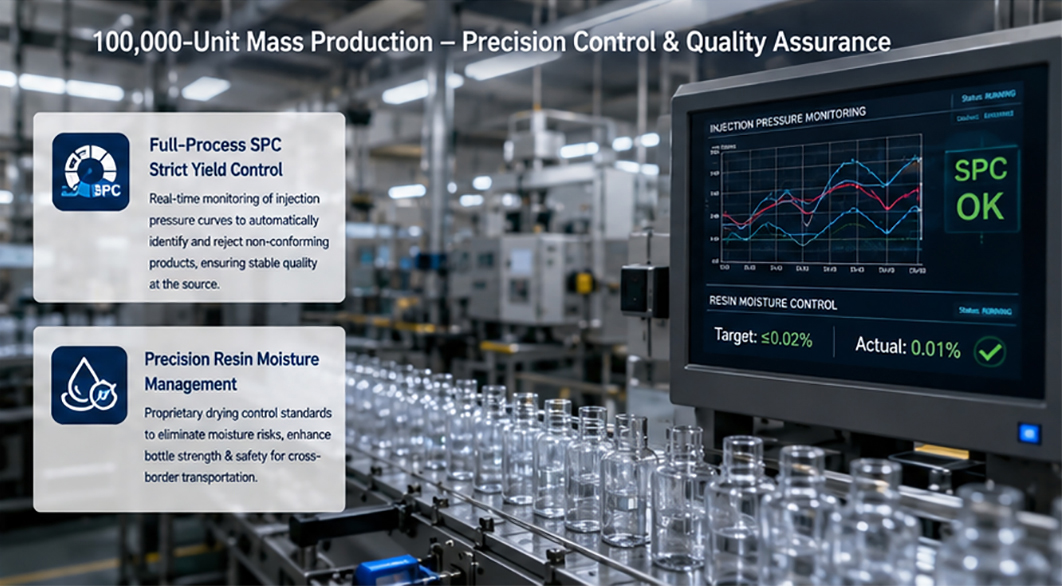
We implemented Statistical Process Control (SPC) throughout production. All injection molding machines were equipped with high-precision cavity pressure sensors to monitor injection pressure curves in real time. By automatically identifying and rejecting non-conforming products based on curve overlap, we achieved visualized, standardized production, stabilizing product quality at the process source and preventing defects.
2、Precision Resin Moisture Management – Eliminating Hidden Mass Production Risks
Plastic resin moisture content is an invisible but critical factor affecting packaging service life and transport safety. Excessive moisture triggers hydrolysis, significantly reducing bottle internal pressure strength. Such defects are hard to detect visually and can easily cause bottle bursting or leakage during cross-border transport. We established proprietary resin drying control standards, precisely managing drying temperature, duration, and final moisture content, monitoring raw material status throughout to eliminate hidden quality risks and ensure safe cross-border delivery.
3、Project Core Value: Unlocking Competitiveness in the Canadian High-End Beauty Packaging Market
This case clearly demonstrates the industry logic of the Canadian high-end market: the client’s stringent requirements essentially force a systemic upgrade of the beauty supply chain. To succeed in the Canadian market, a packaging supplier’s core advantages are no longer just low price and high capacity, but three key barriers: compliance capability, technical problem-solving ability, and long-term service capability.
1. Compliance Capability as a Core Market Asset
By proactively aligning with Canadian regulatory standards, we mitigated compliance risks early and provided clients with compliance optimization suggestions, significantly reducing their audit costs and compliance risks. This elevated us from a备选 supplier to a preferred strategic partner.
2. Long-Term Service Orientation Builds High-Value Cross-Border Trust
Six months of long-cycle communication and five rounds of high-cost sampling are investments many short-sighted suppliers avoid. However, in B2B cross-border cooperation, the core value lies precisely in long-term relationship building. This long-cycle, high-investment approach to requirement analysis and technical refinement significantly raises cooperation barriers and client stickiness. The initial 100,000-unit order is just the starting point; based on the deep trust established, continued strategic collaboration will unlock larger repeat orders, achieving mutually beneficial long-term gains.
Conclusion
This Canadian cosmetic plastic bottle customization project marks a fundamental capability upgrade for our factory. We have moved beyond the traditional “order-taking → production → delivery” manufacturing role to become a “dedicated technical consultant” throughout the project lifecycle, offering one-stop services from needs diagnosis and feasibility analysis to technical problem-solving and mass production risk control.
Our factory’s competitiveness has evolved from “how much we can make and how low the price is” to “how many client problems we can solve and how much technical responsibility we can assume.” This successful collaboration shattered the old perception of “Chinese factory = low-cost manufacturing,” establishing a strategic partnership based on professional service and long-term trust, and creating irreplaceable trust assets for future million-scale orders.
Contents
Submit Your Request
To Provide You With Professional Services

Request Free Sample