Cosmetic Packaging OEM/ODM Case Study: 3-Year Stable Supply Chain & Global Compliance

Against the backdrop of accelerating global supply chain restructuring and increasingly stringent environmental regulations, the packaging industry has evolved far beyond traditional “container manufacturing.” Today, it has become a comprehensive service industry integrating engineering design, material science, digital collaboration, and international compliance capabilities.
Based on a real-world strategic partnership project between our company and a long-term core client, this report explores how a three-year deeply integrated collaboration—supported by the stable annual production of 5 million customized packaging bottles—helped establish a resilient competitive barrier capable of withstanding global market volatility.
More importantly, this case not only represents a high-standard OEM/ODM collaboration model, but also serves as a practical preview of how the packaging industry is entering the “Compliance & Sustainability Era” leading into 2026. Through multidimensional analysis covering R&D innovation, scalable manufacturing, global regulatory adaptation, and economic performance, this report demonstrates a critical market reality: in today’s highly competitive beauty and personal care market, long-term growth is no longer driven by low pricing alone, but by stable quality premiums and rapid technological iteration.
Over the past several years, packaging has shifted from being viewed as a “cost center” to becoming a core component of brand value. As the first physical touchpoint between products and consumers, packaging now directly influences perceived quality, user experience, and brand identity.
The strategic significance of this project therefore extends beyond manufacturing volume. Its true value lies in eliminating the inefficiencies and instability caused by fragmented procurement systems through long-term supply chain integration.
For beauty, personal care, and household product brands, maintaining annual production volumes of 5 million packaging units requires far more than physical manufacturing capacity. It demands operational redundancy, rapid response capability, and stable supply resilience under fluctuating market conditions.
In other words, long-term competitiveness is determined not by whether a factory can manufacture products once, but whether it can consistently maintain quality, delivery stability, and scalable responsiveness during periods of raw material volatility, seasonal demand surges, and global logistics disruptions.
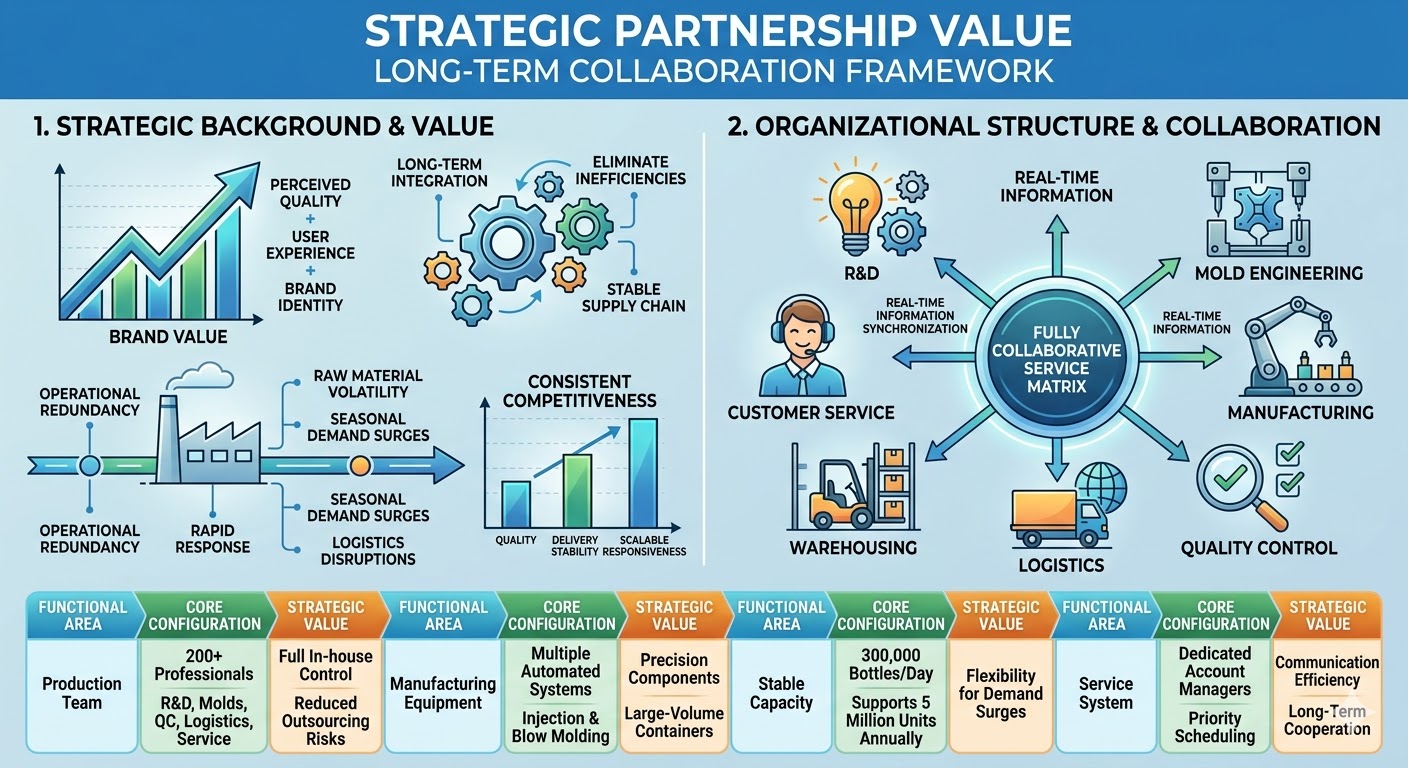
To support this strategic partnership, our company assembled a dedicated team of over 200 professionals covering R&D, mold engineering, manufacturing, quality control, logistics, warehousing, and customer service.
Rather than operating as isolated departments, these teams were integrated into a fully collaborative service matrix that enabled real-time information synchronization throughout the entire production lifecycle.
This full-chain collaboration capability is especially critical in the beauty and personal care industry, where rapid SKU iteration requires packaging suppliers to shorten the transition from concept design to physical production within weeks. As a result, industry competition today is no longer defined solely by manufacturing speed, but increasingly by organizational responsiveness and cross-functional coordination efficiency.
|
Functional Area |
Core Configuration & Standards |
Strategic Value |
|
Production Team |
200 professionals covering R&D, mold development, QC, logistics, and customer service |
Full-process in-house control with reduced outsourcing risks |
|
Manufacturing Equipment |
Multiple automated injection and blow molding systems |
Capability covering both precision components and large-volume containers |
|
Stable Production Capacity |
300,000 bottles per day |
Supports annual 5 million-unit demand while maintaining surge flexibility |
|
Service System |
Dedicated account managers and priority scheduling mechanisms |
Strengthens communication efficiency and long-term collaboration |
The three-year collaboration created substantial operational synergies between both parties.
As cooperation deepened, our factory gained a comprehensive understanding of the client’s product launch cycles, seasonal sales patterns, and inventory planning requirements. This enabled proactive raw material procurement and production capacity reservation in advance.
Such stability proved particularly valuable during periods of global supply chain instability, including raw material inflation, energy crises, and international logistics disruptions.
Through shared-risk mechanisms and long-term production planning, the partnership effectively minimized the risk of packaging shortages that could otherwise lead to product stockouts at the retail level.
In the beauty and personal care market, aesthetics and functional innovation are equally important.
Over the past three years, our company developed 20 exclusive bottle designs for this client. These developments were not merely cosmetic changes, but comprehensive upgrades involving structural engineering, material optimization, and user experience enhancement.
Ultimately, a packaging supplier’s R&D capability directly influences a brand’s ability to differentiate itself in highly competitive retail markets.
Unlike traditional OEM factories that rely heavily on external mold suppliers, our company operates an independent in-house mold workshop.
This capability significantly shortened development lead times from the industry average of 45–60 days to approximately 15–25 days. In the fast-moving consumer goods industry, this reduction in development time represents a critical competitive asset.
Our one-stop development service includes 3D rendering, structural engineering validation, and prototype sampling.
Today, high-quality 3D visualization has become an essential tool in modern B2B collaboration. According to industry studies, advanced 3D visualization technologies can reduce design communication costs by nearly 47% while shortening product launch cycles by several weeks.
Source: Deloitte Digital Manufacturing Report; McKinsey Design Operations Insights.
Through digital simulation and virtual prototyping technologies, we are able to evaluate lighting effects, ergonomic grip performance, and dispensing behavior before physical mold cutting begins, thereby significantly reducing later-stage development risks.
Advanced packaging development is not limited to visual aesthetics. It also requires rigorous engineering control over structural details.
To address common industry issues such as leakage, deformation, and filling compatibility, we established systematic optimization mechanisms during the early development stage:
Precise tolerance calculations for bottle neck threading and gasket pressure balancing help maintain sealing integrity during long-distance sea transportation and air pressure fluctuations.
By integrating ergonomic data analysis, we optimized weight distribution and grip comfort for large-capacity personal care bottles, enhancing user experience during daily use.
Structural reinforcement ribs were engineered to improve vertical load-bearing performance during pallet stacking and international shipping, thereby reducing transportation losses.
Our manufacturing system covers a complete range of molding and surface finishing processes, including injection molding, blow molding, glass forming, silk-screen printing, hot stamping, electroplating, spraying, UV coating, and matte finishing.
This full-process capability allows us to support both premium beauty packaging and large-scale mass-market personal care products within the same integrated production ecosystem.
At the same time, our flexible manufacturing model supports seamless switching between low-volume trial orders and large-scale mass production, aligning perfectly with modern brand strategies centered on rapid testing and scalable replication.
The real challenge behind an annual demand of 5 million packaging units is not simply the ability to produce, but the ability to maintain consistent, stable, and defect-controlled production over time.
To achieve this, we established a highly automated production management system supported by refined process control standards.
The value of automation extends far beyond labor reduction. Its core purpose is minimizing human variability and ensuring production consistency.
Under a daily output environment exceeding 300,000 bottles, even minor process deviations can create significant batch-level quality risks.
To address this challenge, we integrated sensor-based monitoring systems and machine vision inspection technologies capable of real-time detection of dimensional accuracy, wall thickness consistency, and surface defects.
This standardized production capability effectively solves one of the largest concerns for global buyers: long-term batch consistency.
|
Delivery Segment |
Standardized KPI |
Client Value |
|
Standard Lead Time |
30–40 days |
Reduced inventory pressure and predictable planning |
|
Production Transparency |
Real-time production and QC updates |
Enhanced supply chain visibility |
|
Capacity Flexibility |
Rapid manpower and equipment adjustment |
Support for seasonal replenishment demand |
|
Export Protection |
Reinforced anti-shock and moisture-resistant packaging |
Reduced transportation losses |
We established dedicated enterprise-level customer service systems and ERP-based production transparency mechanisms for major accounts.
Clients are able to monitor production stages, quality inspection progress, and logistics status in real time, significantly improving operational predictability.
In the 2026 global retail environment, this level of supply chain transparency has become an industry standard rather than a premium feature. Major retailers such as Walmart and Amazon increasingly require suppliers to maintain OTIF (On Time In Full) performance rates above 95%.
Source: Gartner Supply Chain Benchmark Reports; Walmart Supplier Standards; Amazon Vendor Compliance Guidelines.
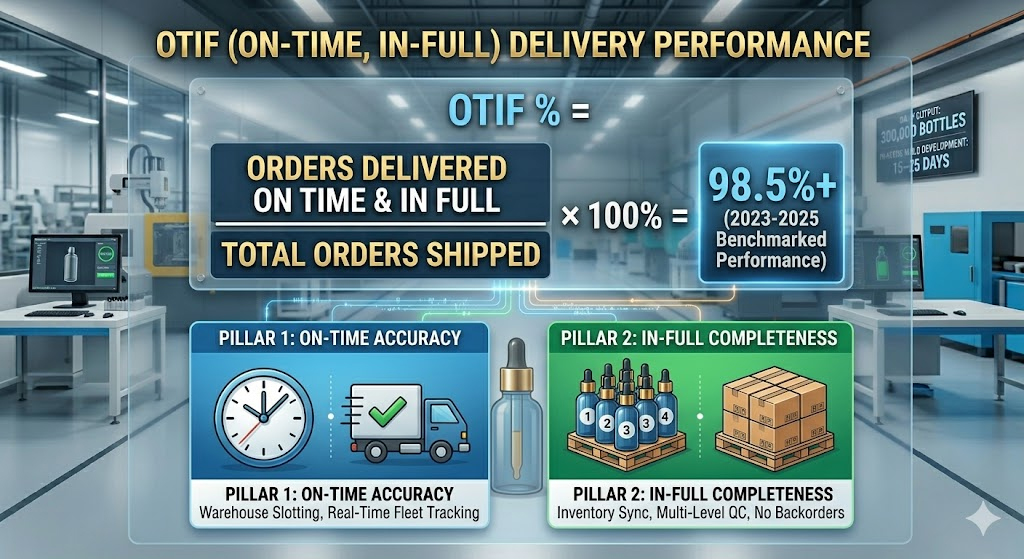
Based on internal project data collected over the three-year cooperation period, the OTIF performance of this project consistently remained above 98.5%, significantly exceeding industry averages.
Data Source: Internal ERP production and delivery records (2023–2025).
The global packaging industry is approaching a major regulatory turning point.
With the implementation of the European Union’s Packaging and Packaging Waste Regulation (PPWR), alongside stricter global restrictions on carbon footprint reporting and PFAS-related chemicals, traditional material selection strategies are rapidly becoming obsolete.
Source: European Commission PPWR Proposal; OECD Sustainable Packaging Reports.
Future competitiveness will increasingly depend on material safety, sustainability compliance, and global regulatory adaptability.
Long-term quality stability begins with raw material integrity.
For this reason, our company strictly uses food-grade and cosmetic-grade virgin materials while refusing to reduce costs through uncontrolled recycled scrap blending.
Although some low-cost suppliers utilize recycled scrap materials to reduce pricing, such practices frequently result in odor issues, yellowing, material instability, and chemical migration risks. In the beauty industry, these failures can quickly escalate into brand reputation crises and legal liabilities.
To ensure global compliance, all customized products are supported by complete COA (Certificate of Analysis) documentation and regulatory safety declarations for each material batch.
Our pricing strategy is based on long-term operational value rather than aggressive low-price competition.
From a business perspective, packaging procurement should never be evaluated solely by unit cost. Instead, brands must consider the full operational risk associated with quality instability.

From a Total Cost of Ownership (TCO) perspective, low-cost packaging often creates significantly higher downstream operational risks.
Large-scale leakage incidents, deformation problems, or quality fluctuations may result not only in packaging losses, but also in expensive product waste, retailer penalties, customer complaints, and long-term brand damage.
Therefore, the 10–15% pricing premium associated with higher-standard manufacturing is ultimately an investment in operational stability and risk reduction.
With over 5–10 years of experience in customized packaging manufacturing, our company has accumulated extensive expertise across global export markets.
This expertise extends beyond manufacturing itself and includes a deep understanding of regional compliance standards, environmental conditions, and consumer market expectations.
For example:
● European and North American markets increasingly emphasize sustainability audits and corporate social responsibility compliance.
● Middle Eastern markets require enhanced heat resistance, UV stability, and oxidation resistance due to extreme climate conditions exceeding 40°C.
By integrating these regional requirements into early-stage product development, we help clients proactively reduce market entry risks.
Throughout this three-year partnership, we consistently maintained stable production standards without reducing wall thickness, lowering material quality, or shortening curing processes in response to raw material fluctuations.
This commitment to manufacturing integrity ultimately became the foundation of long-term client trust.
For trading companies and global distributors, the most valuable asset is not short-term profit margin, but long-term supply reliability and reputation stability.
By consistently delivering stable quality, accurate lead times, and transparent collaboration, we help our clients strengthen their own credibility and competitive positioning in global markets.
Contents
Submit Your Request
To Provide You With Professional Services

Request Free Sample