Within the global cosmetics supply chain, China has evolved far beyond being merely a low-cost manufacturing base. It has transformed into a comprehensive ecosystem integrating R&D, design, production, and logistics. According to the latest customs data and industry research, China’s total cosmetics import and export value exceeded RMB 170 billion (approximately USD 24.8 billion) in 2025. China has not only become the world’s largest cosmetics consumer market, but has also established an irreplaceable core position in cosmetic packaging manufacturing. This leadership is driven not only by its massive production scale, but also by its highly specialized and clustered industrial structure.

The maturity of China’s cosmetic packaging industry is reflected in its unique supply chain ecosystem. The three major industrial clusters represented by Zhejiang, Guangdong, and Suzhou in Jiangsu Province bring together the entire supply chain, from raw material suppliers and mold developers to injection molding specialists, surface treatment factories, and export logistics providers. This geographic concentration significantly reduces both manufacturing and communication costs, creating a highly agile and cost-efficient sourcing environment for global buyers.
|
Core Industrial Cluster
|
Major Cities/Regions
|
Core Advantages
|
Main Product Types
|
|
Zhejiang Cluster
|
Shangyu, Ningbo, Hangzhou
|
Precision engineering, high-end injection molding, export-oriented manufacturing
|
Airless bottles, lotion pumps, premium cream jars, custom tubes
|
|
Guangdong Cluster
|
Guangzhou, Shenzhen, Dongguan
|
Trading hub, rapid prototyping, OEM/ODM integration
|
Bottle accessories, makeup packaging, private label products
|
|
Jiangsu Cluster
|
Suzhou, Wuxi
|
Concentration of foreign-invested factories, high quality standards
|
International-brand packaging, functional components
|

Despite rising tariffs imposed by markets such as the United States, China’s cosmetic packaging industry continues to maintain strong competitiveness in terms of total landed cost. This is largely due to China’s long-term advantages in mold development, labor efficiency, and supply chain coordination. For example, the cost of developing a precision multi-cavity mold in China is often only a fraction of that in Europe or North America, while development cycles can be nearly 50% shorter. Such efficiency is critical for beauty brands that rely on rapid product iteration and fast responses to social media trends.
How Procurement Managers Can Quickly Find Suitable Chinese Manufacturers
For overseas buyers, efficiently identifying qualified suppliers among thousands of Chinese manufacturers remains a major challenge. Today, global buyers typically rely on a combination of online platforms, wholesale markets, international trade fairs, and industry associations to conduct sourcing research.
The Internet Has Greatly Reduced Supplier Search Costs
Online platforms have become the primary gateway for overseas buyers seeking Chinese suppliers. Through big data filtering and supplier verification systems, these platforms help reduce information asymmetry in international trade.
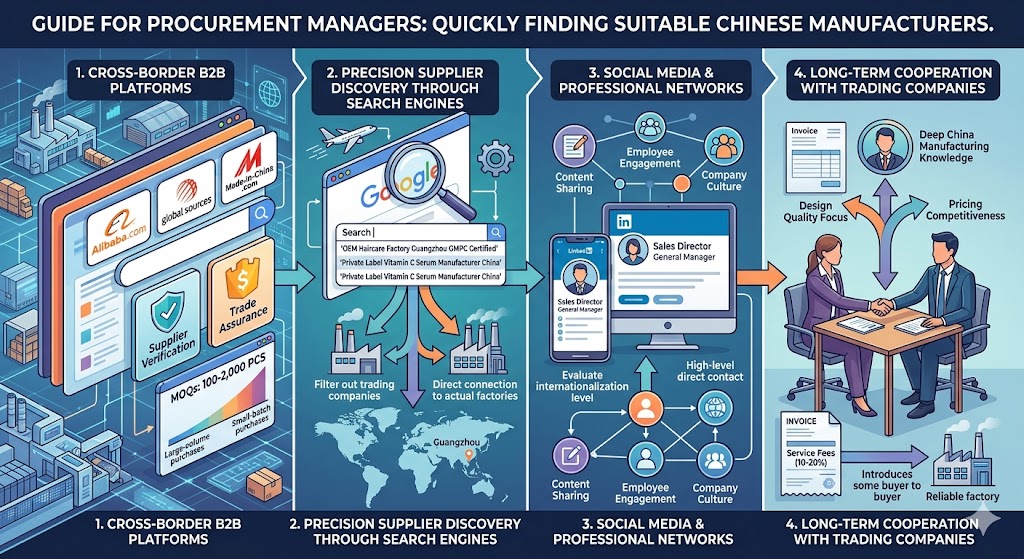
1. Cross-Border B2B Platforms
Alibaba.com, Global Sources, and Made-in-China.com are currently the three most widely used B2B sourcing platforms among international buyers. These platforms not only provide extensive product catalogs, but also offer verification programs such as “Gold Supplier” certifications and trade assurance services, helping buyers evaluate supplier credibility and production capabilities.
High-quality manufacturers on these platforms can support both large-volume procurement and small-batch inventory purchases, with MOQs typically ranging from 100 to 2,000 pieces.
2. Precision Supplier Discovery Through Search Engines
Experienced sourcing teams often use search engines such as Google as highly targeted sourcing tools. By searching professional keywords such as “OEM Haircare Factory Guangzhou GMPC Certified” or “Private Label Vitamin C Serum Manufacturer China,” buyers can directly locate manufacturers with independent English-language websites optimized for international markets.
This method helps filter out many trading companies and allows buyers to connect directly with actual factories.
3. Social Media and Professional Networks
LinkedIn has become increasingly important in high-level procurement. Buyers can identify factory sales directors or general managers and evaluate a company’s internationalization level and corporate culture through their professional activities, content sharing, and employee engagement.
4. Long-Term Cooperation With Trading Companies
Long-term partnerships with reliable trading companies can help buyers identify suitable manufacturers more efficiently. Experienced trading companies often have deep knowledge of the Chinese manufacturing landscape and can recommend factories based on either design quality or pricing competitiveness.
However, buyers should also consider the additional service costs involved, as trading companies typically charge service fees of approximately 10%–20%.
Wholesale Markets and On-Site Visits
Although digital sourcing platforms are highly convenient, physical inspections remain essential in the cosmetic packaging industry, where texture, finishing details, and color accuracy are critical.
1. Yiwu International Trade City
Yiwu is home to the world’s largest small commodities wholesale market. District 3 is especially concentrated with cosmetic packaging suppliers. It is particularly suitable for small beauty brands, Amazon sellers, Shopify businesses, and startups.
Yiwu’s biggest advantages are its enormous product variety and relatively flexible MOQs, usually ranging from 500 to 3,000 units, making it ideal for market testing.
2. Guangzhou Cosmetic Packaging Markets
As China’s beauty industry trade hub, Guangzhou hosts major professional wholesale centers such as Xingnan Market, Meibo City, and Yifa Plaza.
These markets feature a high proportion of factory-direct suppliers and are located near numerous cosmetic OEM factories, making them especially suitable for buyers seeking integrated “formula + packaging” solutions.
|
Guangzhou Market
|
Location
|
Target Buyers
|
Core Advantages
|
|
Xingnan Market
|
Baiyun District
|
Brand owners, wholesalers
|
Factory-direct supply, ideal for private label customization
|
|
Guangzhou Meibo City
|
Guangyuan West Road
|
Beauty professionals, foreign trade buyers
|
Strong industry networks, complete OEM ecosystem
|
|
Yifa Plaza
|
Baiyun District
|
Importers, distributors
|
Highly competitive pricing, suitable for bulk procurement
|
Industry Trade Shows and Offline Networking
International exhibitions remain critical for building industry connections and identifying emerging trends.
1. Cosmoprof Asia
Usually held in Hong Kong every November, Cosmoprof Asia is one of the most influential beauty trade shows in Asia and globally. Buyers can directly communicate with engineering teams from leading packaging manufacturers.
2. Luxe Pack Shanghai
Focused on luxury design and sustainable packaging, Luxe Pack Shanghai is an important venue for premium beauty brands seeking innovative materials and advanced production technologies.
3. PCHi (Personal Care and Homecare Ingredients Exhibition)
Although primarily focused on raw materials, PCHi also showcases extensive packaging technologies and manufacturing equipment, making it highly valuable for buyers concerned with formula-packaging compatibility.
Core Challenges in Cosmetic Packaging Procurement
Despite the many advantages of China’s supply chain, overseas buyers still face significant operational challenges involving production structures, technical limitations, regulations, and geopolitical risks.
MOQ Conflicts Across Multiple Production Layers
Minimum order quantity (MOQ) requirements remain one of the largest barriers in cross-border procurement.
In the cosmetics industry, packaging procurement often involves multiple MOQ layers:
● Formula production may require only 500–2,000 units
● Plastic bottles often require MOQs of 3,000–10,000 units
● Customized printed labels or tubes may require 5,000–20,000 units
These constraints stem from the cost structure of injection molding production. Mold installation, machine calibration, and color switching generate significant fixed costs and material waste.
For startups, meeting MOQ requirements can create substantial inventory risks and cash flow pressure.
Technical Compatibility and Quality Consistency
Cosmetic packaging is far more than a simple container. It must interact safely with complex chemical formulations.
1. Formula Compatibility Risks
Certain fragrances, essential oils, or active ingredients may cause plastics to discolor, crack, or absorb active compounds. Without proper 4–8 week stability testing, brands may face large-scale product recalls after launch.
2. Batch Consistency Challenges
Maintaining consistency in color, pump pressure performance, and printing accuracy during mass production is one of the greatest tests of a factory’s quality control capability.
Pump failures, leakage, and printing misalignment remain among the most common quality complaints in international procurement.
Tariff Fluctuations and Supply Chain Resilience
Geopolitical risks have become a central component of sourcing strategies.
High tariffs imposed by the United States on Chinese plastic packaging products have significantly increased landed costs. At the same time, logistics disruptions, shipping rate volatility, and geopolitical tensions such as the Red Sea crisis continue to challenge global supply chain stability.
As a result, many brands have adopted a “China Plus One” strategy by exploring backup production in Vietnam, India, or Mexico.

However, in practice, these regions still heavily rely on China for raw materials and critical packaging components such as lotion pumps and specialty sprayers. Their mold development capabilities and skilled labor density also remain significantly behind China.
Technological Innovation and Sustainability Trends in Plastic Packaging
As environmental awareness grows worldwide, sustainable packaging has evolved from a marketing advantage into a regulatory requirement. Chinese manufacturers are currently among the global leaders in this transition.
The Application and Challenges of PCR Plastics
Post-consumer recycled (PCR) plastics are one of the core solutions for achieving a circular economy. However, using PCR materials in cosmetic packaging presents strict technical challenges.
1. Migration Risks and Safety
Research indicates that 100% recycled HDPE bottles may carry higher chemical migration risks compared to virgin materials. Certain compounds such as BPA and fragrance-related substances have been detected in PCR materials but not in virgin plastics.
To balance safety and sustainability, industry experts often recommend PCR ratios between 30%–50%, combined with multilayer co-extrusion technology that uses a thin virgin plastic barrier layer inside the container.
2. Aesthetic and Brand Consistency Challenges
PCR plastics often develop darker tones or visible particles during thermal reprocessing, affecting transparency and color purity.
For premium beauty brands that prioritize visual sophistication, this presents a major challenge. However, leading Chinese suppliers are increasingly able to deliver high-PCR containers with appearance quality approaching virgin resin standards.
|
PCR Ratio
|
Environmental Impact
|
Visual Appearance
|
Technical Challenges
|
|
10%
|
Entry-level carbon reduction
|
Nearly identical to virgin plastic
|
Easy to implement
|
|
30%
|
Industry gold standard
|
Slight haze or particles
|
Requires migration risk evaluation
|
|
50%–100%
|
Strong sustainability image
|
Visible color variation and graininess
|
Reduced mechanical performance, higher compliance risks
|
Strategic Recommendations and Procurement Framework
To successfully navigate China’s complex sourcing environment, buyers should establish a standardized seven-step procurement framework.
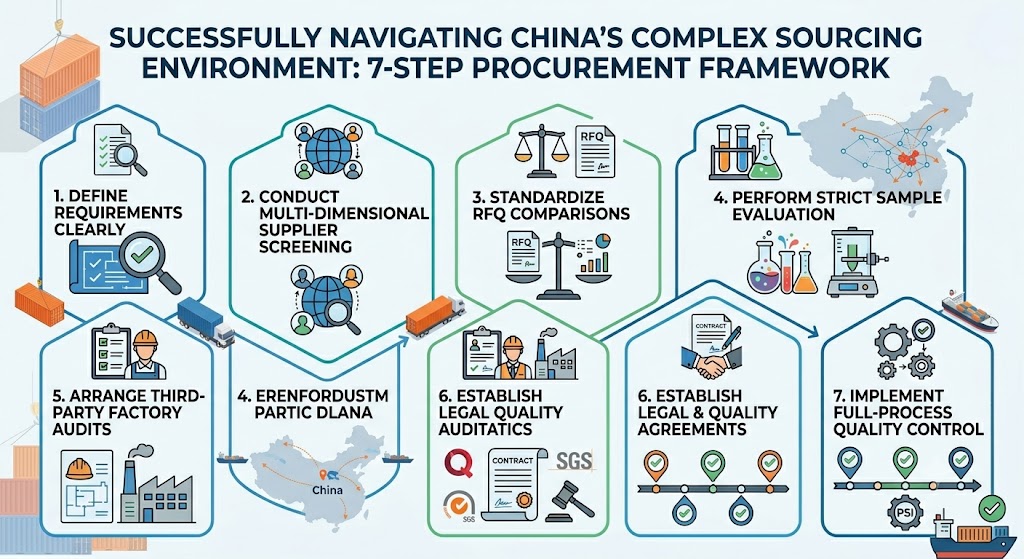
1. Define Requirements Clearly
Specify materials (PET/PP/PCR), capacity, neck size, and barrier requirements before contacting suppliers.
2. Conduct Multi-Dimensional Supplier Screening
Collect at least 5–10 candidate suppliers through B2B platforms, search engines, and trade shows, then perform background checks.
3. Standardize RFQ Comparisons
Require detailed quotations including:
● Unit pricing
● Mold costs
● Sample fees
● Lead times
● Tiered pricing by order volume
4. Perform Strict Sample Evaluation and Compatibility Testing
Conduct real-formula filling tests, evaluate printing adhesion, pump tube length, and sealing performance.
5. Arrange Third-Party Factory Audits
For large orders, use professional audit agencies such as QIMA, SGS, or Intertek to inspect factory operations, quality systems, equipment maintenance, and working conditions.
6. Establish Legal and Quality Agreements
Use bilingual contracts specifying quality standards, defect handling procedures, delivery penalties, and enforceable legal protections.
7. Implement Full-Process Quality Control
Conduct inspections during production and before shipment. Pre-shipment inspection (PSI) remains the final critical safeguard against defective products entering the market.
Conclusion and Future Outlook
China is no longer simply the world’s low-cost manufacturing base for the cosmetics industry. It has evolved into a highly integrated ecosystem combining R&D, precision manufacturing, agile supply chains, and sustainable innovation.
In cosmetic packaging specifically, China has secured an irreplaceable global leadership position through the highly specialized industrial clusters of Zhejiang, Guangdong, and Jiangsu.
Although buyers still face challenges such as MOQ conflicts, technical compatibility risks, and tariff fluctuations, China’s supply chain continues to maintain strong advantages in overall landed cost, mold development efficiency, production flexibility, and sustainable packaging innovation.
With continued advancements in PCR technologies, intelligent manufacturing, and supply chain integration, China’s role in the global cosmetic packaging industry is expected to become even more influential in the years ahead.