In the global beauty market of 2026, plastic cosmetic bottles have long since moved beyond their basic role as mere containers for products. They are undergoing a profound transformation—from materials to form—and have become a key vehicle for brands to fulfill their sustainability commitments, convey personalized narratives, and enhance their core competitiveness.
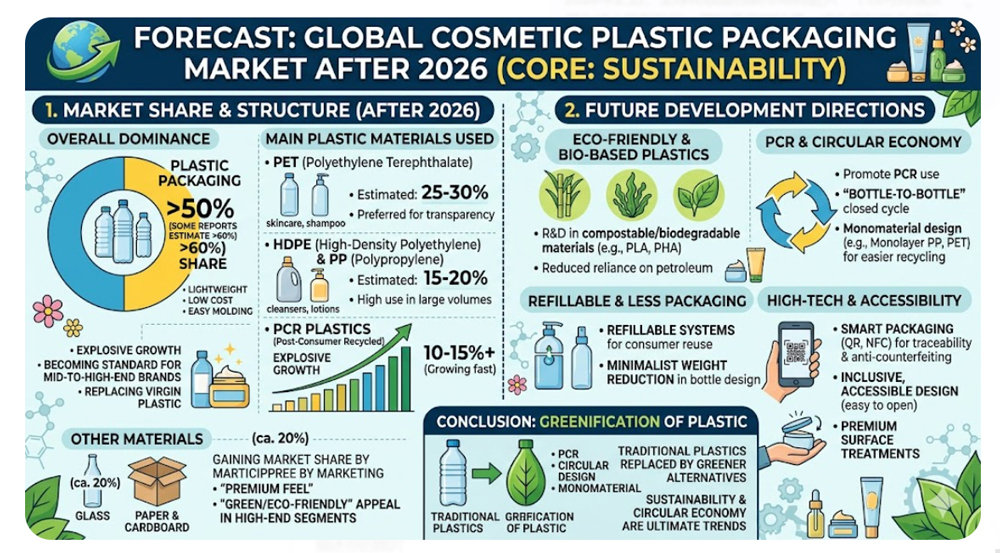
There are actually several mainstream options for “recyclable/eco-friendly” plastic bottle materials, each with different environmental attributes (recyclability, renewable sources, biodegradability, etc.). The most common recyclable plastic materials: PET (polyethylene terephthalate), HDPE (high-density polyethylene), and post-consumer recycled (PCR) plastic.
Features of PET:
· High transparency and excellent texture (very similar to glass)
· 100% recyclable (with the most established global recycling system)
· Can be processed into recycled material (PCR+PET/rPET)
· Made from PCR (post-consumer recycled plastic)
Features of HDPE:
· Opaque or translucent
· High strength and resistance to compression
· Good chemical stability
Features of PCR:
PCR plastic, post-consumer recycled plastic, recycled plastic packaging, sustainable plastic materials, circular economy plastics
In the global beauty industry, “speed” and “originality” are the ultimate weapons brands use to capture global market attention. Leveraging our proprietary, patented innovative technology, we elevate plastic packaging from a mere consumable to a brand’s “unreplicable” strategic asset, helping clients rapidly establish a distinct competitive edge—from visual appeal to sensory experience—in a highly homogeneous market.
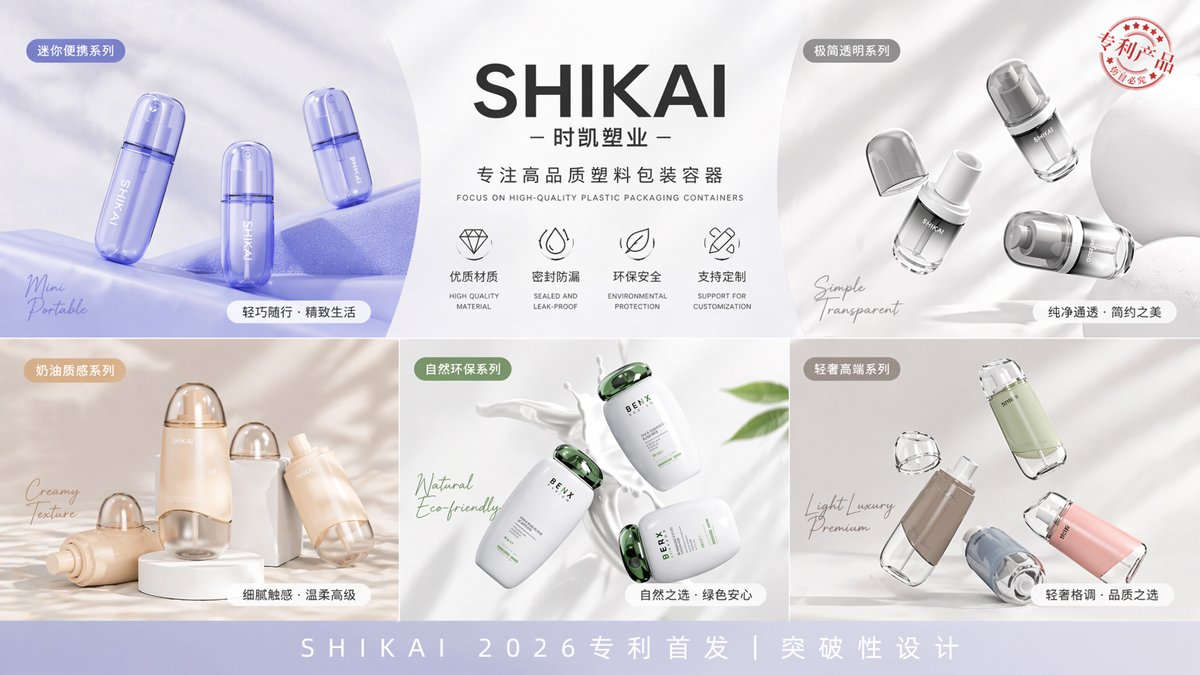

1) Visual Differentiation
Break free from generic, cookie-cutter designs. With unique shapes, textures, and craftsmanship, these products instantly catch the eye on store shelves and e-commerce pages, helping you move beyond the race to the bottom on pricing.
2) Enhance Product Quality and Aesthetics
Original designs paired with personalized craftsmanship elevate the premium appeal of beauty products, aligning with the aesthetic standards of mid-to-high-end brands.
3) Strengthen Brand Recognition
A distinctive shape creates a unique visual symbol that deepens consumer recall, helping clients build a distinctive brand image.
4) Flexible Customization
We can innovate flexibly to incorporate market trends, functional requirements, and usage scenarios, meeting customization needs for niche products, limited editions, gift sets, and more.
One-stop packaging solutions: The market demands service providers capable of offering end-to-end services—from creative design and material R&D to smart manufacturing, efficient delivery, and support for recycling. This requires suppliers to possess cross-disciplinary integration capabilities and become reliable strategic partners for brands.
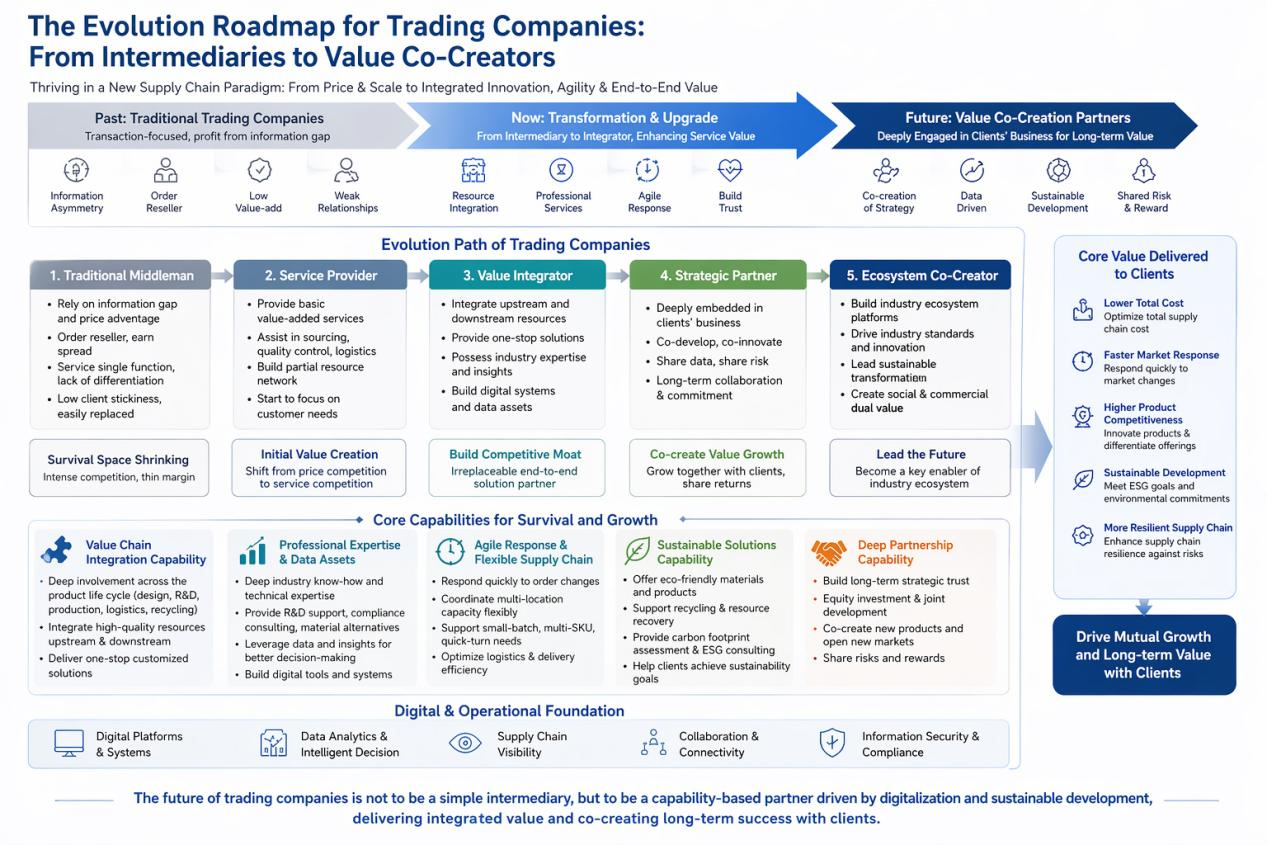
A Fundamental Shift: Competition in the supply chain has evolved from a contest of price and scale to a comprehensive competition centered on integrated innovation capabilities, responsiveness, and end-to-end service value.
Is there still a future for trading companies?
As the competitive landscape in the supply chain shifts from a focus on “price and scale” to one centered on “integrated innovation capabilities, responsiveness, and end-to-end service value,” traditional trading companies will not be completely replaced, but their roles will undergo a profound transformation. Middlemen who rely solely on information asymmetries to profit from price differentials will gradually lose their place in the market, while trading companies capable of quickly adapting to trends and providing high-value-added services will continue to thrive and grow.
|
Dimension
|
Characteristics of Trading Companies That Will Be Eliminated
|
Characteristics of Trading Companies That Will Survive & Thrive
|
Core Reason for Survival
|
|
1. Order Volume (Client's Order Size)
|
Fragmented, unstable orders. Relies on scattered inquiries and one-off transactions. Low customer switching cost leads to high order volatility based on price fluctuations.
|
Centralized, strategic order portfolios. Maintains a few but deeply bonded core brand clients. Orders are consistent, stable, and large-scale, often as the exclusive or primary supplier, integrated into the client's annual procurement plan.
|
Brands seek to ensure stability, consistency, and confidentiality in their full-chain solutions, preferring to consolidate major orders with a comprehensive strategic partner rather than fragmenting them among multiple suppliers. The high switching cost inherent in deep collaboration locks in order volume.
|
|
2. Customer Trust
|
Transactional trust based on price. The relationship is fragile; trust breaks with a lower quote. Trust exists only for single deliveries.
|
Strategic trust based on value. Trust derives from problem-solving capability and commitment to shared risk. Brands view them as an extension of their own supply chain, willing to share market insights and co-develop new products.
|
In an integrated model, trading companies are deeply involved in the client's R&D, production, and marketing, accessing core knowledge and data. Such collaboration must be built on a foundation of long-term reliability and mutual trust. Trust is the prerequisite for all high-value-added services.
|
|
3. Services Provided
|
Single, replaceable services. Only provides basic services like information matching, logistics coordination, and payment facilitation, which are easily replaced by digital platforms or direct brand-factory connections.
|
Diverse, high-value-added integrated services. Provides a one-stop suite including market insight & design, material R&D & testing, supply chain finance, lean production management, and ESG compliance & circular solutions. The core is "service integration" and "innovation enablement."
|
These services directly address brands' core pain points of needing "more than just manufacturing." By integrating specialized resources (design, R&D, factories), trading companies provide capabilities that brands lack or find too costly to develop in-house, thereby creating irreplaceable value. Deeper service integration leads to stronger client stickiness.
|
Against the backdrop of profound transformations in the global beauty market in 2026, Foshan Shikai Plastic Technology Co., Ltd. is redefining the commercial value of packaging through its forward-looking environmental strategy and deep technical expertise. By fully adopting 100% recyclable materials such as PET, HDPE, and PCR+PET, the company has transformed “sustainability” from a mere slogan into an integral part of its product DNA; At the same time, with 50 uniquely designed patented products launched annually, Shikai has not only successfully transformed packaging from a mere “container” into a “vehicle for brand storytelling,” but also, through high-performance, differentiated patented designs, helps beauty brands build core competitive barriers in the green market, leading the global beauty packaging industry toward low-carbon, smart, and personalized solutions.